
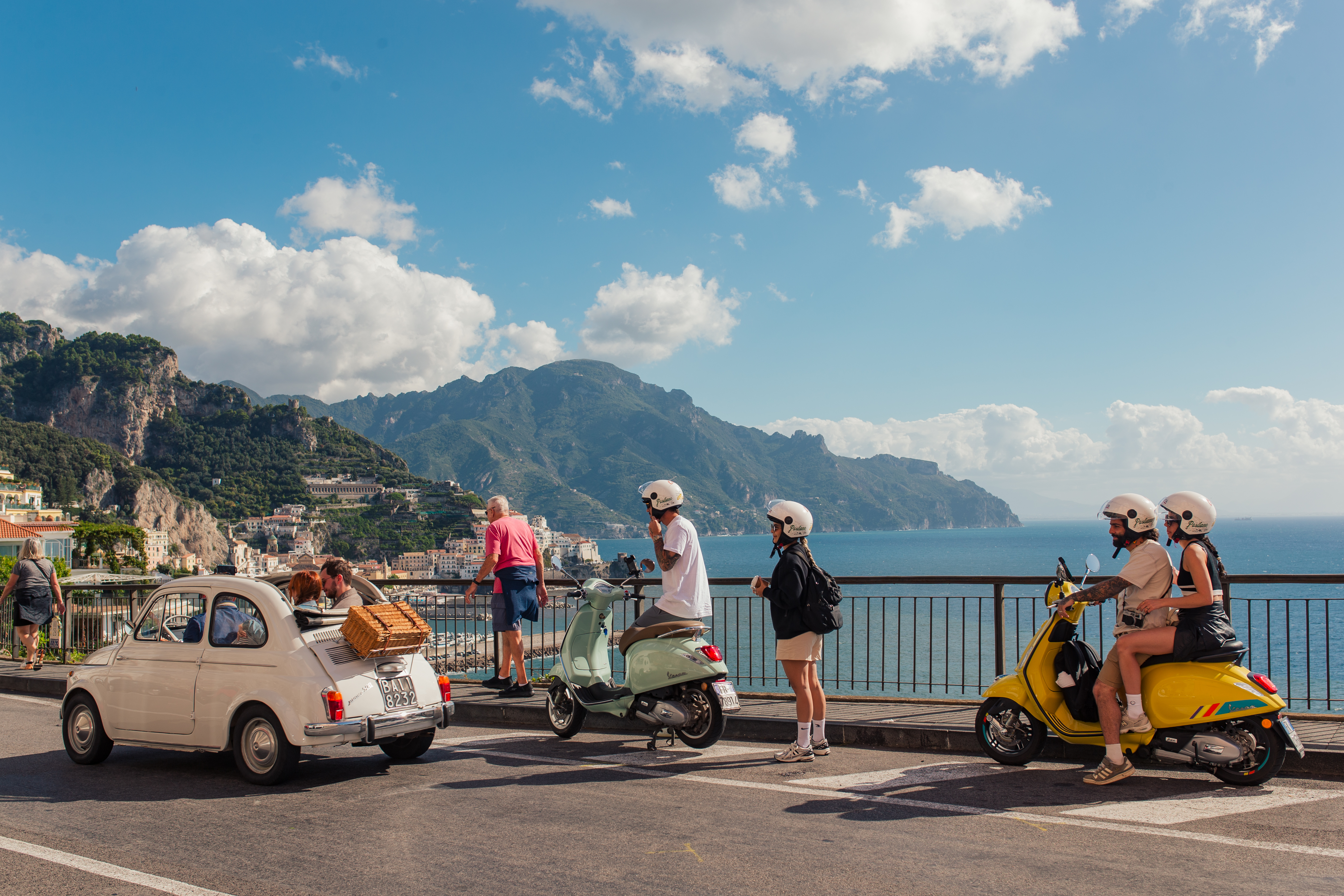
- Shoulder season (April–May, September–October) often offers the best balance of weather, prices, and crowds
- High-speed trains are the easiest way to travel between major cities – book ahead for the lowest fares
- Carry some cash, dress modestly for churches, and skip the cappuccino after lunch
Italy rewards travelers who arrive with a little local knowledge. The country’s regions can feel like different worlds—the pace of life in Sicily has little in common with Milan’s—but a few practical rules apply almost everywhere.
Whether you’re traveling to Italy for the first time or returning for your fifth trip, these Italy travel tips cover when to go, how to get around, and the everyday etiquette that makes a visit run smoothly.
When to visit Italy
Italy is a year-round destination, but your experience changes dramatically depending on the season. Spring (April–May) and fall (September–October) bring mild temperatures, manageable crowds, and landscapes at their best – wildflowers in Tuscany, grape harvests in Piedmont.
Summer delivers long days and a packed festival calendar, but also intense heat in the cities. Rome and Florence regularly exceed 95°D in July and August. Winter is quiet and atmospheric in the cities, with opera seasons in full swing and ski resorts open across the Alps and Dolomites.
One date worth knowing is Ferragosto, on August 15. Italians traditionally take their own vacations around this time, so many family-run restaurants and stores in the cities close for a week or more, while the coast fills up.
Peak vs. off-peak
Peak season runs from June to August, when accommodation prices are highest and lines at major attractions are longest.
Off-peak (November to March, excluding Christmas and Carnevale in Venice) brings the lowest prices and the shortest queues, though some coastal towns—particularly on the Amalfi Coast and in Cinque Terre—partially shut down, with hotels and restaurants closed until spring.
The shoulder months are the sweet spot for most first-time visitors – you’ll pay less than in summer, the weather is reliable enough for sightseeing, and the headline sights are busy but not overwhelming.
How long to stay in Italy
A week is enough for a satisfying first time trip to Italy, but resist the temptation to cram it. A common mistake is attempting Rome, Florence, Venice, the Amalfi Coast, and Lake Como in seven days – you’ll spend more time on trains than in piazzas.
A better rhythm is two or three bases per week of travel. With one week, pair Rome and Florence, or Venice and the lakes. With ten days to two weeks, you can comfortably add a third region and still have time for the long lunches that are half the point of coming.
If you’re planning a return visit, consider skipping the headline cities entirely and basing yourself in one region – Puglia, Sicily, Umbria, or Emilia-Romagna all reward a slower pace.
How to get around Italy
Knowing how to travel around Italy is mostly a question of matching the transportation to the terrain. Trains connect the cities brilliantly while cars unlock the countryside. In a few places, boats are the only way in.
Car rental
A rental car is the right choice for rural Tuscany, Puglia, Sicily, and the Dolomites – and the wrong one for city-to-city travel. The single most important thing to understand before driving in Italy is the ZTL (Zona a Traffico Limitato) – restricted traffic zones in the historic centers of most cities and many small towns.
Cameras photograph every car that enters and fines arrive by mail months later, often with rental company admin fees added. Check whether your accommodation sits inside a ZTL before you book and ask the property to register your number plate if it does.
You’ll need an International Driving Permit alongside your license if you hold a non-EU license and most rental cars are manual. Automatics cost more and sell out, so reserve early.
High-speed trains (Frecciarossa and Italo)
Italy’s high-speed rail network is one of the best in Europe and for routes such as Rome–Florence (around 1.5 hours) or Milan–Naples, it beats flying once you account for airport transfers.
Two operators compete on the main lines: Trenitalia’s Frecciarossa and the privately run Italo. The competition keeps fares reasonable, but pricing works like airlines – book a few weeks ahead and you can pay a fraction of the walk-up fare. Seats are reserved, luggage travels with you at no extra charge, and stations sit in city centers.
Regional trains and buses
Regional trains (Regionale) are slower, cheaper, and require no reservation – ideal for short hops such as Florence to Pisa or the towns of Cinque Terre. If your regional ticket doesn’t carry a specific date and time, you must validate it in the small green-and-white machines on the platform before boarding.
An unvalidated ticket can mean an on-the-spot fine and pleading tourist ignorance rarely works. Buses fill the gaps where trains don’t reach, including much of the Amalfi Coast, Siena, and rural Sicily. Tickets are usually bought in advance from tabaccherie (tobacconists) rather than from the driver in these areas.
Taxis and ride shares
Official taxis are white, metered, and picked up at ranks or booked by phone or app – hailing on the street is not the norm. Ride-sharing as you may know it from home barely exists.
The FreeNow app, which books licensed taxis, is the most useful one to download. Agree or confirm fixed airport fares before setting off: Rome, for example, has a set rate between Fiumicino Airport and the city center.
Where to stay during your trip to Italy
Where you base yourself shapes your trip as much as what you see. These four hubs anchor most first itineraries and each has its own logic.
Rome
Rome merits three nights at a minimum – the Vatican alone consumes a morning. Staying in the centro storico (around the Pantheon and Piazza Navona) puts you within walking distance of the major sights.
Whereas Monti offers a more local feel beside the Colosseum, and Trastevere delivers the classic cobbled-lanes-and-trattorias atmosphere across the river. Book major attractions such as the Colosseum and Vatican Museums well in advance. Same-day tickets are increasingly rare.
Florence
Florence is compact enough to cross on foot in half an hour, so almost any central neighborhood works. The area around the Duomo is convenient but busy. The Oltrarno, south of the river, trades a few minutes’ walk for artisan workshops, quieter evenings, and some of the city’s best aperitivo spots.
Florence also makes a practical base for day trips into Tuscany – Siena, San Gimignano, and the Chianti wine region are all within easy reach.
Venice
Two pieces of advice for Venice: Stay overnight and stay on the islands rather than in Mestre on the mainland. The city transforms after the day-trippers leave and evenings in a quiet campo are when Venice is at its best.
There’s also a financial aspect to keep in mind: On 60 selected dates between April and late July 2026, day visitors must register and pay an access fee of €5 (rising to €10 if booked fewer than four days ahead).
Overnight guests are exempt from the charge, though they still need to register for a QR code on the official portal during fee periods. For neighborhoods, Cannaregio and Castello offer a more residential pace than the area immediately around St Mark’s Square.
Napoli (Amalfi coast)
Naples is the gateway to the south: Gritty, exuberant, and home to Italy’s best pizza. It works well as a base for Pompeii and Herculaneum, both a short Circumvesuviana train ride away.
For the Amalfi Coast itself, decide between staying on the coast (Positano and Amalfi are beautiful and priced accordingly while Praiano and Minori are calmer alternatives) or visiting by ferry on day trips from Sorrento or Salerno. In summer, ferries beat the coastal road – the famous drive is spectacular but slow and buses get crowded.
Essential things to know before traveling to Italy
Tipping
Tipping in Italy is modest and never obligatory. Service staff earn proper wages and most bills already include a coperto – a cover charge of €1–3 per person for bread and the table itself. Rounding up the bill or leaving a few euros for excellent service is appreciated but leaving 20% will mark you as a tourist. Nobody tips at the coffee bar.
Coffee culture
Coffee in Italy follows rules and breaking them is the quickest way to stand out. A cappuccino is a breakfast drink – ordering one after lunch or dinner raises eyebrows, as milky coffee is considered too heavy after a meal.
From late morning onwards, the default is a simple espresso (just ask for un caffè). Drinking it standing at the bar is cheaper than sitting at a table, where prices can double or triple, especially on famous squares.
Tap water
Tap water is safe to drink throughout Italy and the free public fountains—Rome’s nasoni are the most famous—dispense cold, drinkable water all day. Bring a refillable bottle.
In restaurants, however, asking for tap water is uncommon. You’ll typically be offered bottled acqua naturale (still) or frizzante (sparkling), typically for €2–3.
Dress code for churches
Italy’s churches are working places of worship and the dress code is enforced at major sites including St Peter’s Basilica, the Duomo in Milan, and St Mark’s in Venice: Shoulders and knees covered, for all genders. In summer, carry a light scarf or wrap so a spontaneous church visit doesn’t end at the door. Hats off inside and keep voices low – particularly during services.
Mealtimes
Italian mealtimes run later than many visitors expect. Lunch is roughly 12:30 pm to 2:30 pm while dinner rarely starts before 7:30 pm and in the south, locals often sit down at 9:00 pm or later.
Outside these windows, many kitchens just close – a restaurant serving dinner at 5:30 pm is catering to tourists, which tells you something about the food. If you’re hungry between meals, an aperitivo (a drink with snacks, from around 6:00 pm) bridges the gap gracefully.
Cash and card
Card acceptance has improved enormously – businesses are legally required to accept electronic payments and contactless works almost everywhere in cities.
Still, carry some cash: Small bars, market stalls, rural trattorias, and tabaccherie may grumble at cards for tiny amounts and a few stubbornly remain cash-first. Withdraw from bank-attached ATMs (bancomat) and decline dynamic currency conversion – always choose to be charged in euros.
Riposo and opening hours
Many stores, churches, and smaller museums close in the early afternoon, typically between 1:00 pm and 4:00 pm – the riposo (rest). It’s most pronounced in small towns and the south, where summer afternoons empty the streets entirely.
Plan sightseeing around it: Mornings for stores and churches, afternoons for major museums (which generally stay open) or a long lunch of your own. Note too that many museums close on Mondays.
Book the big sights ahead
The days of strolling into the Uffizi or the Last Supper on a whim are over. Timed-entry tickets for headline attractions – the Colosseum, Vatican Museums, Uffizi, Accademia, and Leonardo’s Last Supper in Milan – should be booked days or, in some cases, weeks ahead, directly through official sites to avoid resale mark-ups. Pompeii and the Borghese Gallery in Rome also cap daily visitor numbers.
Top things to do when visiting Italy
The greatest hits earn their reputation:
- The Colosseum and Vatican in Rome
- Renaissance art in Florence
- Gondola-laced canals in Venice
- The ruins of Pompeii
Beyond the icons, build in time for the experiences that don’t require a ticket – an evening passeggiata (the ritual pre-dinner stroll), a market morning in Bologna, a swim off the Ligurian coast, or a slow drive through the Val d’Orcia. Italy’s best moments tend to happen between the sights.
Italy travel tips: Hidden spots
For every famous destination, Italy offers a quieter counterpart:
- Bologna instead of Florence for food
- Verona or Padua instead of Venice for canals and frescoes
- Lecce in Puglia for baroque architecture without the crowds
- Matera’s ancient cave dwellings
- The trulli houses of Alberobello
- The islands of Procida and Ponza
These hidden spots reward travelers willing to go one step beyond the classic route.
Ready to travel to Italy?
Visiting Italy doesn’t demand much preparation – just enough to work with the country’s rhythms rather than against them. Travel in the shoulder seasons if you can, let the trains do the intercity work, book the blockbuster sights ahead, and keep your afternoons flexible. Get those basics right and Italy does the rest: The food, the art, and the landscapes take care of themselves. All that’s left is to choose where to stay and start planning.
Disclaimer: The views and opinions expressed are those of the author and don't necessarily reflect the official policy or position of our company.